Mirror-Testing A Deep Dive into Cognitive Abilities of Animals
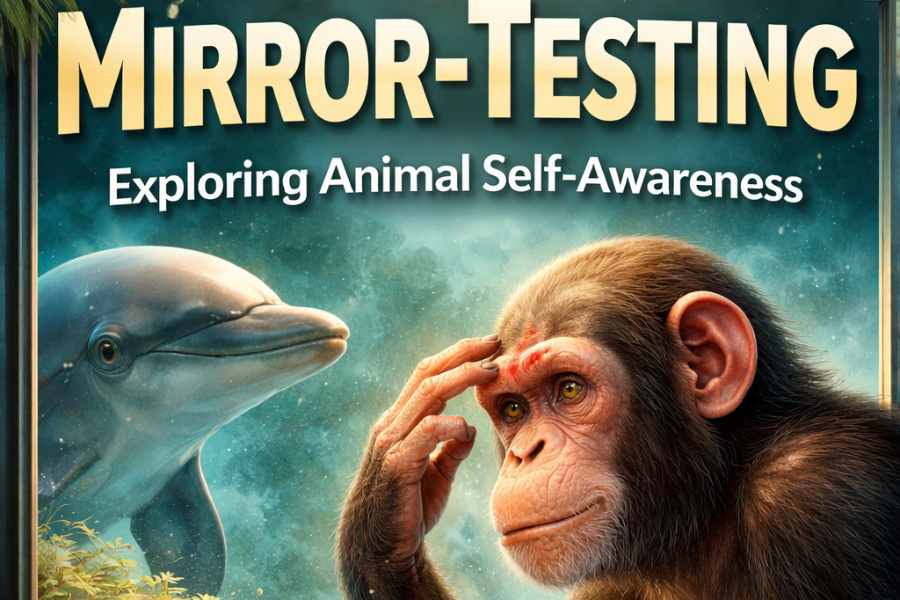
Mirror-testing is one of those simple ideas that opens the door to big questions. At its core, it asks whether animals can recognize themselves in a mirror—but the answers go far beyond a simple yes or no. In recent years, especially with the latest 2026 research, this test has revealed surprising insights about animal intelligence and self-awareness. From dolphins to tiny reef fish, scientists are discovering that awareness may exist in more forms than we ever imagined. This growing field not only challenges old beliefs but also invites us to rethink how we understand the minds of animals and their place in our world.
The 2026 Headline: A Tiny Fish Changed Everything
Let’s start with the discovery that’s getting the most attention.
In early 2026, scientists studying cleaner wrasse fish found something remarkable. These small reef fish didn’t just respond to mirrors—they interacted with them in ways that looked almost experimental.
When researchers placed fake “parasite-like” marks on the fish, the wrasse used mirrors to inspect and try to remove them. That part alone is impressive. But what really stood out was what happened next.
Some fish began dropping small bits of food in front of the mirror and watching how the reflection behaved.
Think about that for a second.
That’s not just reacting—that’s testing cause and effect.
Scientists call this “contingency testing,” and it’s usually seen in highly intelligent animals like dolphins.
Seeing it in a fish? That’s the kind of moment that makes researchers pause and rethink everything.
Faster Than Ever: Awareness in Minutes, Not Days
Another detail from the 2026 research makes the story even more interesting.
In earlier mirror tests, animals often took days to show self-recognition behaviors. But these fish? Some reacted within about an hour.
That speed suggests something important:
Maybe the fish weren’t “learning” self-awareness from the mirror.
Maybe they already had some level of awareness—and the mirror simply revealed it.
That’s a subtle but powerful shift in thinking.
A Growing Realization: Self-Awareness Might Be Everywhere
For decades, the story was simple.
Humans are self-aware.
Great apes are self-aware.
Maybe dolphins and elephants too.
Everyone else? Probably not.
But findings like these are breaking that idea apart.
Cleaner wrasse have now joined a list that includes mammals, birds, and other species that show mirror self-recognition.
And suddenly, scientists are asking a very different question:
What if self-awareness didn’t evolve once—but many times?
Or even more surprising…
What if it’s been there all along, just in different forms?
Mirror-Testing Itself Is Being Re-Evaluated
Here’s where things get even more human—and a bit philosophical.
In 2026, researchers are not just studying animals.
They’re also questioning the test itself.
The mirror test is very visual. It assumes that recognizing yourself means recognizing your reflection.
But not all animals rely on sight the way humans do.
Dogs, for example, live in a world of smell. Some scientists now believe they might recognize themselves through scent instead of vision—something a mirror simply can’t measure.
So if a dog “fails” the mirror test, is it really failing?
Or are we just asking the wrong question?
That’s a big shift happening right now in 2026:
from judging animals… to rethinking our methods.
The New Idea: Self-Awareness Isn’t One Thing
One of the most important updates coming out of recent research is this:
Self-awareness is not a single ability.
It’s more like layers.
Some animals may understand their bodies.
Some may understand social relationships.
Some may recognize themselves visually in a mirror.
And some—like those cleaner wrasse—might even explore how their reflection behaves.
Instead of a strict pass/fail system, scientists are starting to see a spectrum of awareness.
And honestly, that makes a lot more sense.
Even “Failures” Are Being Reconsidered
Another quiet but important change in 2026 is how scientists view animals that don’t pass the mirror test.
Take gorillas, for example.
They’ve often struggled with mirror recognition. But newer studies suggest they have strong body awareness and problem-solving skills—just expressed differently.
This tells us something simple but powerful:
Just because an animal doesn’t recognize itself in a mirror
doesn’t mean it lacks awareness.
It might just think in a different way.
What This Means for How We See Animals
If you step back and look at all these updates together, they point toward one big realization:
Animals are probably a lot more aware than we’ve given them credit for.
Not in a “they think like humans” way—but in their own unique ways.
A fish inspecting its reflection.
A bird checking its body in a mirror.
An elephant exploring parts of itself it can’t normally see.
These are not random behaviors. They suggest something deeper—some form of inner experience.
And once you start seeing that, it’s hard to ignore.
A Small Personal Thought
Here’s something I keep coming back to.
We used to think intelligence was easy to spot. Big brains, complex behavior, human-like thinking.
But now, a tiny fish in a reef is forcing scientists to rethink that entire idea.
There’s something humbling about that.
It reminds us that intelligence—and maybe even awareness—doesn’t always look the way we expect.
Where Mirror-Testing Is Headed Next
Looking ahead, 2026 is just the beginning of a new phase.
Researchers are now:
- Combining mirror tests with brain studies
- Exploring self-awareness in more species (even insects and fish)
- Designing new tests that go beyond vision
The goal isn’t just to see who passes anymore.
It’s to understand how different minds work.
And honestly, that feels like a much more interesting journey.
Final Thought
Mirror-testing started as a simple experiment.
But in 2026, it’s become something much deeper—a way of questioning not just animals, but our own assumptions.
Because the more we learn, the clearer it becomes:
We’re not the only ones experiencing the world in meaningful ways.
We’re just one version of it.