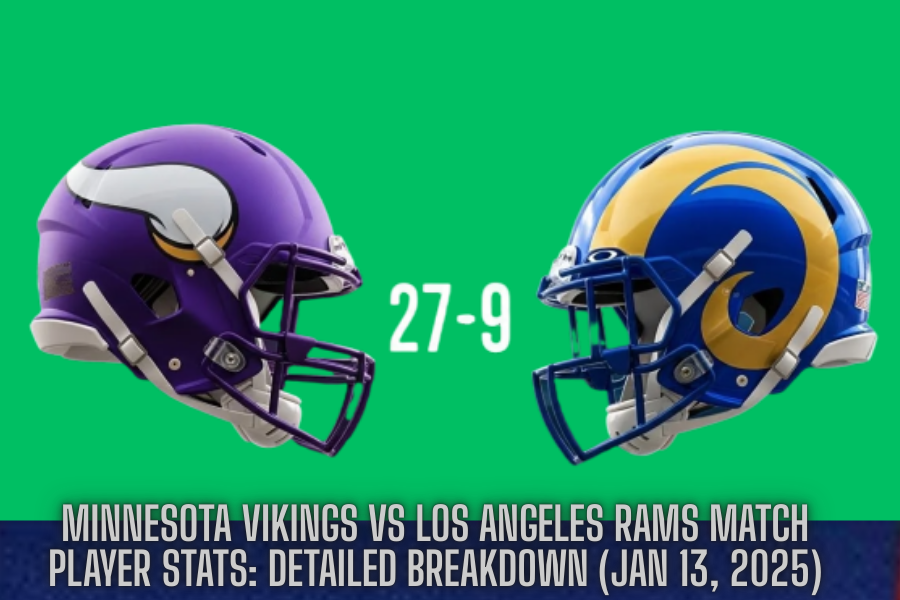
The NFC Wild Card matchup between the Minnesota Vikings and the Los Angeles Rams on January 13, 2025, will be remembered not only for the scoreline but also for its dramatic context and historic performances. Originally scheduled to take place in Los Angeles, the game was relocated to State Farm Stadium in Glendale, Arizona, due to devastating wildfires in California. Despite the relocation, approximately 45,000 Rams fans made the 400-mile trip east, creating an electric atmosphere alongside the Minnesota supporters. Under the closed retractable roof, the Monday night kickoff at 8:00 PM ET set the stage for what would become a defensive masterclass from the Rams and a frustrating night for the Vikings’ offense.
Ultimately, the Rams demolished the Vikings 27–9, dominating the game both offensively and defensively. This report provides a comprehensive look at the player stats, key moments, and strategies that led to such a lopsided outcome.
Quick Stats Summary
| Category | Vikings | Rams |
| Final Score | 9 | 27 |
| Total Yards | 269 | 292 |
| Turnovers | 2 | 0 |
| Time of Possession | 32:18 | 27:42 |
| Third Down | 6/17 (35.3%) | 2/10 (20.0%) |
| Sacks Allowed | 9 | 2 |
Score by Quarter
| Quarter | Vikings | Rams |
| Q1 | 0 | 10 |
| Q2 | 3 | 14 |
| Q3 | 6 | 3 |
| Q4 | 0 | 0 |
| Final | 9 | 27 |
By halftime, Los Angeles led 24–3, leaving Minnesota struggling to recover. The final numbers illustrate the story: the Vikings’ offensive line collapsed under constant pressure, their receivers couldn’t create separation, and their rushing attack failed to establish any rhythm.
Passing Stats
Minnesota Passing
Sam Darnold struggled under pressure all night, completing 25 of 40 passes for 245 yards, one touchdown, and one interception. His passer rating of 77.6 reflected the difficulty he faced against the Rams’ relentless defense, which recorded nine sacks and tied an NFL playoff record. Darnold lost 82 yards on sacks, holding the ball at least 3.2 seconds on every first-half sack, with four lasting 4.4 seconds or longer.
The Rams used a variety of strategies to disrupt Darnold’s rhythm, including cornerback blitzes, stunts on the defensive line, and coverage rotations that forced him to hold the ball too long. Minnesota’s offensive line was unable to adapt, with Blake Brandel and Dalton Risner struggling against inside moves, while Cam Robinson and the left side were beaten by speed rushers.
Los Angeles Passing
Matthew Stafford was the steadying force for the Rams, completing 19 of 27 passes for 209 yards and two touchdowns, with a passer rating of 117.7. Stafford completed his first 10 passes and consistently dissected Minnesota’s coverage, controlling the game from start to finish. His efficiency helped the Rams maintain possession despite Minnesota holding the clock slightly longer, and his calm, veteran presence ensured that the offensive game plan remained intact.
Rushing Stats
Minnesota Rushing
Minnesota struggled to find momentum on the ground. Aaron Jones led the team with 13 carries for 48 yards (3.7 average), while Cam Akers added 39 yards on five carries (7.8 average). Darnold contributed 19 yards on four attempts. Overall, the Vikings managed 106 rushing yards on 22 carries, with a long of 26 yards, which was insufficient to offset the pressure on Darnold or to create opportunities for the passing game.
Los Angeles Rushing
The Rams leaned on Kyren Williams, who carried 16 times for 76 yards (4.8 average) and scored the opening touchdown. Ronnie Rivers and Puka Nacua contributed as well, though Stafford himself lost a yard on two carries. Los Angeles averaged 4.1 yards per carry over 22 attempts, controlling possession and keeping Minnesota’s offense off balance.
Receiving Stats
Minnesota Receiving
Minnesota’s receiving corps was ineffective under pressure. T.J. Hockenson led the team with five catches for 64 yards and a touchdown, while Justin Jefferson managed 58 yards on five receptions. Deep threats were neutralized by Rams’ safety help and tight coverage, leaving the Vikings to rely on checkdowns. Jalen Nailor, Jordan Addison, and Johnny Mundt combined for 90 yards, but none could provide explosive plays to shift momentum.
Los Angeles Receiving
The Rams had a balanced attack through the air. Tyler Higbee recorded five catches for 58 yards before leaving with a chest injury, opening opportunities for Puka Nacua and Cooper Kupp. Kyren Williams also contributed a receiving touchdown, while rookies like Davis Allen showed their potential. This diversified threat made it difficult for Minnesota’s defense to key in on any single player.
Defensive Stats
Minnesota Defense
The Vikings’ defense was overwhelmed. They recorded only two sacks and five quarterback hits on Stafford, who remained largely unpressured throughout the game. Blake Cashman led with 11 tackles, while Ivan Pace Jr. and Harrison Smith added significant contributions. However, the defensive effort was insufficient to prevent Los Angeles from executing their offensive game plan effectively.
Los Angeles Defense
Los Angeles’ young defensive line dominated, tying an NFL playoff record with nine sacks. Kobie Turner led with 2.0 sacks, while Byron Young and Neville Gallimore added 1.5 each. Jared Verse contributed a critical fumble return for a touchdown, showcasing the impact of a dynamic rookie on a playoff stage. Eight different Rams defenders recorded at least half a sack, demonstrating depth and versatility in their pass rush.
The defensive line combined for 25 quarterback pressures according to Pro Football Focus. The constant pressure forced Darnold into rushed decisions, mistakes, and ultimately led to the collapse of Minnesota’s offensive rhythm.
Special Teams
Kicking
Minnesota’s Will Reichard converted one field goal from 34 yards, scoring their only points outside of the T.J. Hockenson touchdown. In contrast, Joshua Karty converted both his field goal attempts for Los Angeles and added three extra points, contributing nine total points.
Punting
Punter Ryan Wright averaged 44.3 yards on three punts for the Vikings, while Ethan Evans of Los Angeles averaged 50.2 yards on five punts and pinned Minnesota inside the 20 three times. Field position played a key role in limiting Minnesota’s offensive opportunities and giving the Rams advantageous starting spots.
Key Plays and Turning Points
The first half set the tone for the game. Stafford completed all six passes on the opening drive, finishing with a five-yard touchdown to Williams. Minnesota answered with a field goal, but the Rams quickly regained momentum. A third-and-seven fumble by Darnold allowed Jared Verse to scoop the ball and sprint 57 yards for a touchdown, the fastest speed by a 260+ pound player in seven seasons at 19.88 mph.
Minnesota faced a fourth-and-two situation from midfield later in the second quarter, but Kobie Turner’s sack for an 11-yard loss halted any potential comeback. Before the half ended, Stafford connected with Davis Allen for another touchdown, giving Los Angeles a commanding 24–3 lead.
Strategic Analysis
Pass Protection Breakdown
Minnesota’s nine sacks were not random—they were the result of a calculated defensive plan. Los Angeles disguised coverages and executed a mix of blitzes, stunts, and delayed rushes that left Darnold with minimal time to throw. The offensive line could not adjust, with multiple players beaten consistently by inside and outside moves. Four of the nine sacks came on crucial third or fourth downs, preventing the Vikings from sustaining drives.
Offensive Struggles
Minnesota averaged just 3.8 yards per play and failed to convert in the red zone, going 0/1. Their rushing game could not compensate for the pressure on Darnold, and their passing game was limited by tight coverage. Even elite receivers like Justin Jefferson were unable to create explosive plays due to poor protection and quick defensive reads by the Rams.
Defensive Dominance
Los Angeles’ defense applied pressure throughout, limiting Minnesota to two sacks and five QB hits on Stafford while creating key turnovers. Jared Verse’s fumble recovery and touchdown exemplified the Rams’ opportunistic style, combining speed, technique, and awareness to dominate in critical moments. Their young defensive line was a decisive factor in controlling the game and setting the tone for January football.
Individual Highlights
- Sam Darnold: 25/40, 245 yards, 1 TD, 1 INT, 77.6 rating; sacked nine times for 82 lost yards. Struggled under consistent pressure, holding the ball too long and failing to generate explosive plays.
- Matthew Stafford: 19/27, 209 yards, 2 TDs, 117.7 rating. Efficient and calm, completing his first 10 passes and avoiding turnovers despite Minnesota’s attempts to disrupt him.
- Jared Verse: Defensive Rookie of the Year frontrunner; fumble return for 57 yards, 19.88 mph top speed. Shifted momentum and contributed constant pressure on Darnold.
- T.J. Hockenson: Five catches, 64 yards, 1 TD. Minnesota’s only scoring threat outside of field goals.
- Kyren Williams: 16 carries, 76 yards, 1 TD. Controlled possession and limited Minnesota’s offensive opportunities.
Postgame Implications
Minnesota’s 14–4 regular season concluded with a disappointing first-round exit. Their high-powered offense ranked sixth in passing and ninth in scoring during the regular season but faltered under playoff pressure. Questions now surround Darnold’s future, the offensive line’s durability, and whether Aaron Jones’ rushing contributions can continue at age 30. The Vikings face a decision regarding quarterback strategy for the 2025 season, especially with rookie J.J. McCarthy coming off injury.
Los Angeles improved to 11–7 and advanced to the divisional round against Philadelphia. The Rams’ turnaround from a 1–4 start to winning 10 of their final 13 games highlighted the impact of their young defensive line and Stafford’s leadership. Their plus-eight turnover margin since the bye week proved decisive in the Wild Card game and showcased their potential to make a deep playoff run.
Conclusion
The Minnesota Vikings vs Los Angeles Rams Wild Card playoff game on January 13, 2025, will be remembered as a showcase of dominant defensive strategy, veteran quarterback poise, and rookie brilliance. Minnesota’s nine sacks allowed, turnovers, and lack of explosive plays defined their loss, while the Rams’ defense and efficient offense dictated the game from start to finish.
Sam Darnold’s struggles under pressure, contrasted with Matthew Stafford’s control and precision, epitomized the matchup. Jared Verse’s fumble return touchdown provided a momentum swing that Minnesota could not recover from. Despite a 14-win regular season, Minnesota’s playoff aspirations were halted in the first round, reinforcing the harsh reality of January football. Meanwhile, Los Angeles’ 27–9 victory, marked by historic defensive performances, propels them into the next round with momentum and confidence.
This complete player stat breakdown and game analysis highlight not only the individual performances but also the strategic decisions, situational football, and execution that led to the Rams’ convincing victory. The Minnesota Vikings vs Los Angeles Rams match player stats reflect a game where preparation, talent, and opportunistic play defined the postseason outcome.