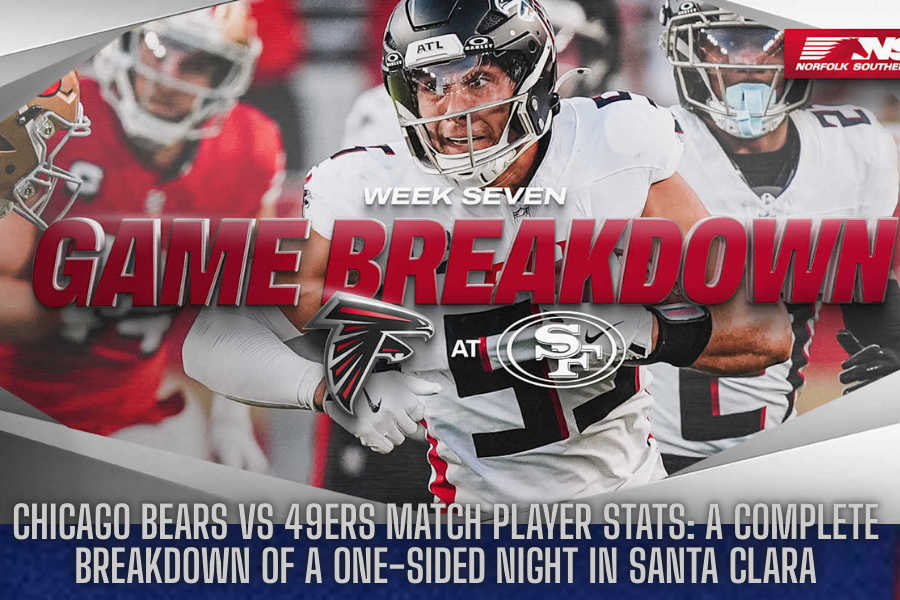
Chicago Bears vs 49ers Match Player Stats: A Complete Breakdown of a One-Sided Night in Santa Clara
When fans circled December 8, 2024, on the NFL calendar, many expected a competitive clash between two historic franchises. Instead, what unfolded at Levi’s Stadium was a statement game from San Francisco and a long, painful night for Chicago. The final score read 49ers 38, Bears 13, but the raw numbers behind it tell an even more dramatic story.
This wasn’t just a win. It was domination in almost every measurable way. Let’s walk through the Chicago Bears vs 49ers match player stats and see how this game slipped away from Chicago so quickly — and why San Francisco looked like a completely different team compared to recent weeks.
How the Game Was Decided Early
Sometimes games are over before halftime. This was one of those nights.
By the end of the first half, San Francisco had outgained Chicago 319 yards to just 4 yards. Yes, four. That single number pretty much summarizes how lopsided the opening 30 minutes were.
The 49ers led 24–0 at halftime, and honestly, it felt even worse than that. Brock Purdy was comfortable, receivers were wide open, and Chicago’s offense looked trapped in survival mode.
Brock Purdy’s Near-Perfect Passing Night
San Francisco 49ers Passing Stats
Brock Purdy played one of the cleanest games of his season.
He completed 20 of 25 passes for 325 yards, threw two touchdowns, and finished with a passer rating of 145.4. Even more impressive, he was sacked just once all night.
Purdy wasn’t forcing throws. He wasn’t scrambling unnecessarily. He simply took what Chicago’s defense gave him — and they gave him a lot.
Both of his touchdown passes went to Jauan Jennings, and several third-down completions kept drives alive when the Bears desperately needed stops. Watching live, it felt like Purdy always had the right answer.
Backup quarterback Brandon Allen threw one late interception in garbage time, but by then the game had long been decided.
Caleb Williams Under Siege All Night
Chicago Bears Passing Stats
On paper, Caleb Williams’ stat line doesn’t look terrible. He completed 17 of 23 passes for 134 yards and threw two touchdowns without an interception.
But context matters.
Williams was sacked seven times, lost 46 yards, and spent most of the night running for his life. In the first half alone, Chicago had negative passing yards after sacks were accounted for.
Both of Williams’ touchdown passes came in the second half when San Francisco had already built a massive lead. Credit to the rookie for staying composed and protecting the football, but this was a brutal environment for any quarterback — especially a first-year player.
Rushing Battle: San Francisco Controlled the Tempo
49ers Rushing Performance
With Christian McCaffrey and Jordan Mason sidelined, many wondered how San Francisco would run the ball. The answer came quickly: Isaac Guerendo.
In his first NFL start, Guerendo rushed 15 times for 78 yards and two touchdowns. He ran with confidence, showed burst through the hole, and kept Chicago’s defense honest.
Patrick Taylor Jr. added a late touchdown, and Brock Purdy chipped in with a few scrambles. San Francisco finished with 131 rushing yards and controlled the pace from start to finish.
Bears Rushing Struggles
Chicago never found any rhythm on the ground.
D’Andre Swift managed just 38 yards on 14 carries, averaging under three yards per attempt. When a team can’t run — and also can’t protect its quarterback — games unravel quickly.
Caleb Williams was actually Chicago’s most effective runner, using his legs to escape pressure and gain 27 yards. But that’s not a recipe for sustainable offense.
George Kittle’s Historic Night
A Milestone Performance
George Kittle didn’t just play well — he made history.
He caught six passes on six targets for 151 yards, averaging over 25 yards per reception. Five of those catches went for more than 20 yards, repeatedly flipping field position.
With that performance, Kittle became only the third tight end in NFL history to reach 500 receptions and 7,000 receiving yards within his first eight seasons, joining Travis Kelce and Antonio Gates.
Watching him play, it was vintage Kittle. Strong hands, violent yards after the catch, and total chemistry with Purdy.
Jauan Jennings and the Receiving Depth
Jennings quietly delivered one of the best games of his career.
He finished with seven receptions for 90 yards and two touchdowns, both coming on third down. Those plays crushed Chicago’s momentum early and made it impossible for the Bears to climb back into the game.
Isaac Guerendo also contributed as a receiver, hauling in two catches for 50 yards, showing real versatility out of the backfield.
San Francisco’s offense didn’t rely on one player — it spread the ball, stayed unpredictable, and stayed efficient.
Bears Receiving: Few Bright Spots
DJ Moore led Chicago with six catches for 49 yards, but he was mostly contained underneath. Keenan Allen reached a major career milestone with his 950th reception, though the moment was overshadowed by the scoreboard.
Rookie Rome Odunze provided the only real highlights for Chicago, catching two second-half touchdowns. His routes looked sharp, and he showed why the Bears believe he’s a foundational piece moving forward.
Still, most of Chicago’s production came once the outcome was already decided.
Defensive Pressure Changed Everything
49ers Defensive Dominance
San Francisco’s defensive line completely overwhelmed Chicago’s offensive front.
They recorded seven sacks, seven tackles for loss, and multiple quarterback hits — all without relying heavily on blitzes.
Yetur Gross-Matos led the way with three sacks, while Leonard Floyd added two more from the opposite edge. Interior pressure from Maliek Collins collapsed the pocket and eliminated any sense of comfort for Williams.
Even without Nick Bosa, this group looked fast, aggressive, and coordinated.
Bears Defense Couldn’t Hold Up
Chicago’s defense was on the field far too often.
T.J. Edwards led the team with 10 tackles and recorded the Bears’ only sack. But overall, the unit struggled with explosive plays and couldn’t slow down San Francisco’s passing attack.
When your offense produces four yards in an entire half, even a good defense will eventually break.
Special Teams and Field Position
The punting numbers tell their own story.
Chicago punter Tory Taylor had to punt six times, while San Francisco’s Pat O’Donnell punted just twice. That alone explains who controlled the game.
Jake Moody was perfect on extra points and added a short field goal. Chicago rarely crossed midfield, so Cairo Santos barely had a chance to impact the game.
The First Half That Broke the Game
Four total yards. One first down. Zero third-down conversions.
That was Chicago’s first half.
San Francisco scored on four of five possessions, while Chicago never crossed midfield. Brock Purdy threw for 258 yards before halftime, and George Kittle already had over 130 receiving yards.
By the time the second half started, the competitive part of the game was already over.
Final Team Stats Tell the Story
San Francisco finished with 452 total yards compared to Chicago’s 162. The 49ers averaged 8.7 yards per play, nearly triple the Bears’ output.
The sack differential — 7 to 1 — highlights how completely San Francisco won the battle at the line of scrimmage.
Even discipline didn’t matter much. Despite committing more penalties, the 49ers were never threatened.
Final Thoughts and Takeaways
This game showed two teams moving in very different directions.
For San Francisco, it was a reminder of who they can be when everything clicks. Brock Purdy looked confident, George Kittle looked unstoppable, and the defense looked angry — in a good way.
For Chicago, it was another painful step in a rebuilding season. Caleb Williams showed toughness and poise, but no quarterback can succeed behind that level of pressure. The talent is there, but protection, consistency, and structure are still missing.
The Chicago Bears vs 49ers match player stats don’t just reflect a loss — they reflect a gap. One team played like a contender fighting for survival. The other looked like a team still searching for stability.
And on this December night in Santa Clara, that difference showed up everywhere.